
LLM Integrations with Company Systems
We integrate language models with CRM, shop, panel, or document workflow — in a single, measurable task without rewriting the entire system.
fromPLN 5,000
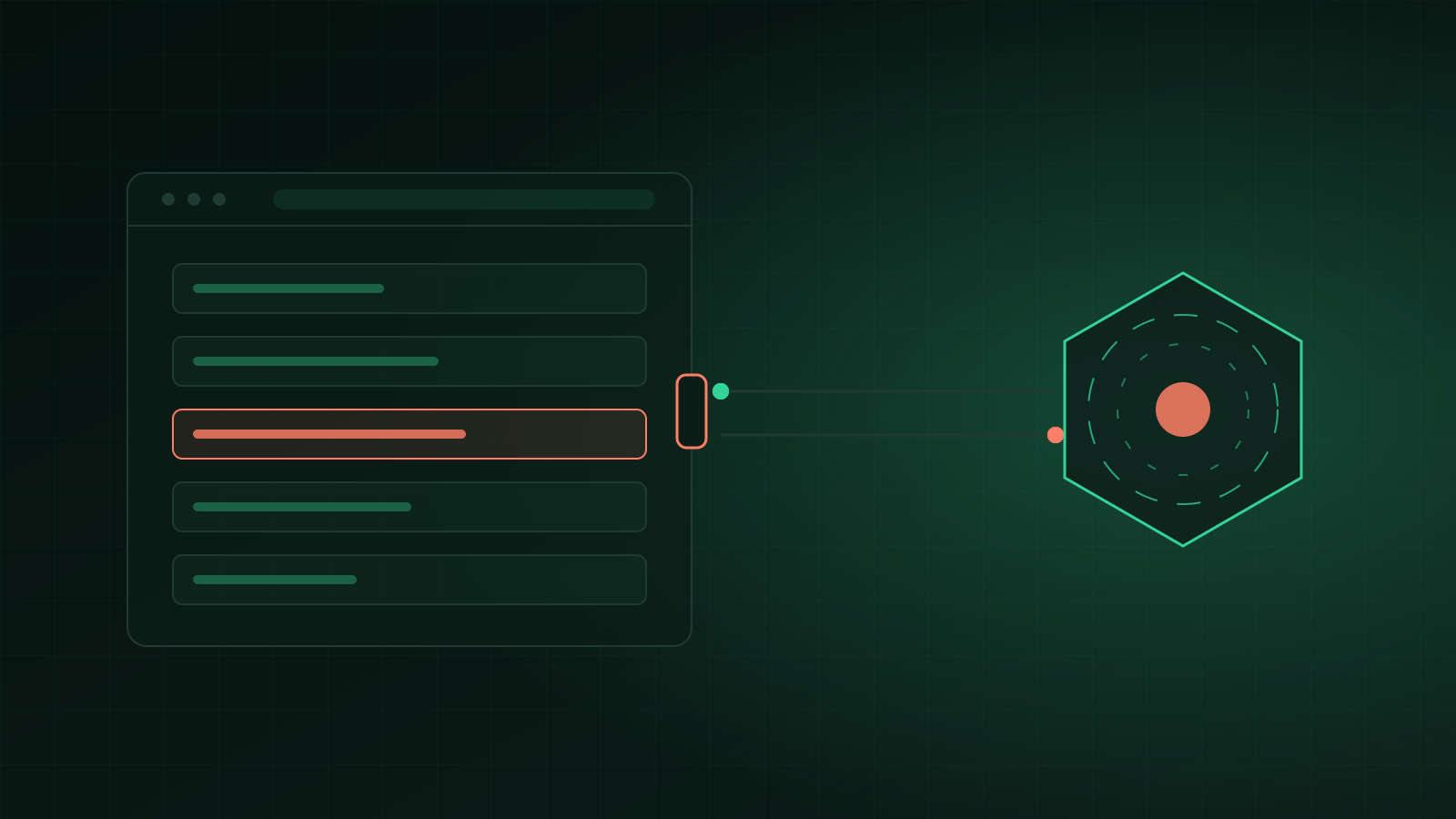
LLM integration means adding a language model to a specific task in an existing system via API and a controlled intermediary layer. It can summarize, classify, extract information, or draft content. It does not require rewriting the entire application, but it does require quality testing, cost control, and clear data-handling rules.
When you need this
- You have a working CRM, shop, panel, or internal tool and one well-defined task for a model.
- The team copies content between the system and a public AI chat, with no data control or execution history.
- You need to compare models by quality and cost on your own cases, not on a vendor demo.
- You want to start with a single integration point before deciding on an agent or a larger platform.
Which integrations make sense?
- classification and routing of tickets to the right queue;
- summarizing long correspondence or a document in the panel where the team already works;
- extracting specific fields from unstructured text;
- a draft description, reply, or quote with mandatory human approval;
- semantic search and answer over an approved knowledge base;
- text data analysis combined with existing system rules.
First, we pick one behavior that can be evaluated. A vague directive like "add AI to our product" is not yet an integration scope.
LLM integration or AI agent?
Integration enriches a defined step. An agent manages a sequence of steps. If the model only needs to return a category, summary, or text proposal for an existing screen, integration is enough. If it must check multiple sources, choose a tool, act, and react to the result, we talk about an AI agent.
What you get
- an integration layer separating your system from the chosen model's API;
- preparation and minimization of data sent to the model;
- a test case set with expected outputs and quality comparison;
- limits, caching, error handling, and usage monitoring;
- human-in-the-loop logic where the output affects a customer or a critical decision;
- documentation of variable costs and how to swap the model in the future.
A single LLM integration costs approximately 5 000–20 000 zł. An AI layer covering several system points or a more complex flow typically falls in the 20 000–60 000 zł range. Fixed API and maintenance costs are quoted separately based on expected usage.
What deployment looks like
We start with representative examples and a correctness criterion. Then we check your system's API availability, data risk, and expected call volume. We build a thin intermediary layer, compare models, test failure behavior, and only then enable the integration in production.
Model selection is not a loyalty pledge to one provider. We choose the solution that meets the quality, latency, data policy, and cost thresholds for the specific task.
How we demonstrate expertise
Our own AI research workflows and analytics platform show models, data, and tools connected in systems used by Condictor. These are our own proofs, not implied client deployments.
When integration is not the right first step
We don't start from a model API when there is no clear task, data is unavailable, the result cannot be verified, or the current process is unnecessary in itself. If the problem is scattered knowledge, a second brain may be more appropriate; for broader uncertainty — an AI audit.
Describe your system, its API, and the task in the brief. In response, we can assess whether a single integration suffices or a larger scope is needed.
FAQ
Do we need to rewrite our system?
No. We plug into what you already have — via API, queues, or an intermediary layer. Changes on your side are kept to a minimum.
How much does it cost monthly?
Beyond implementation, there is usually API usage and maintenance of the integration layer. We design limits, caching, and cost monitoring; the exact level depends on call volume, data length, and the chosen model.
Which model will you choose?
The model that meets the agreed quality, latency, data security, and cost thresholds on your use cases. We compare candidates for the specific task instead of picking a provider based on brand recognition.
How do we know response quality is sufficient?
Before deployment, we set up quality evaluation on your cases: a set of real examples, expected outputs, and measurement. Without this, model integration is guesswork.
What about our data security?
We define what data may be sent to the model, which provider policy applies, and what must stay in your environment. Keys are separated from code, permissions are restricted, and sensitive content is not logged without explicit need.
How does LLM integration differ from an AI agent?
Integration typically enriches a single system step — for example, classifying a ticket or creating a summary. An agent executes a longer task, autonomously selects allowed tools, and proceeds through multiple steps.