
AI Agents for Business - Implementation
We design AI agents that execute tasks in your business process, use the necessary tools, and operate under supervision in production.
fromPLN 8,000
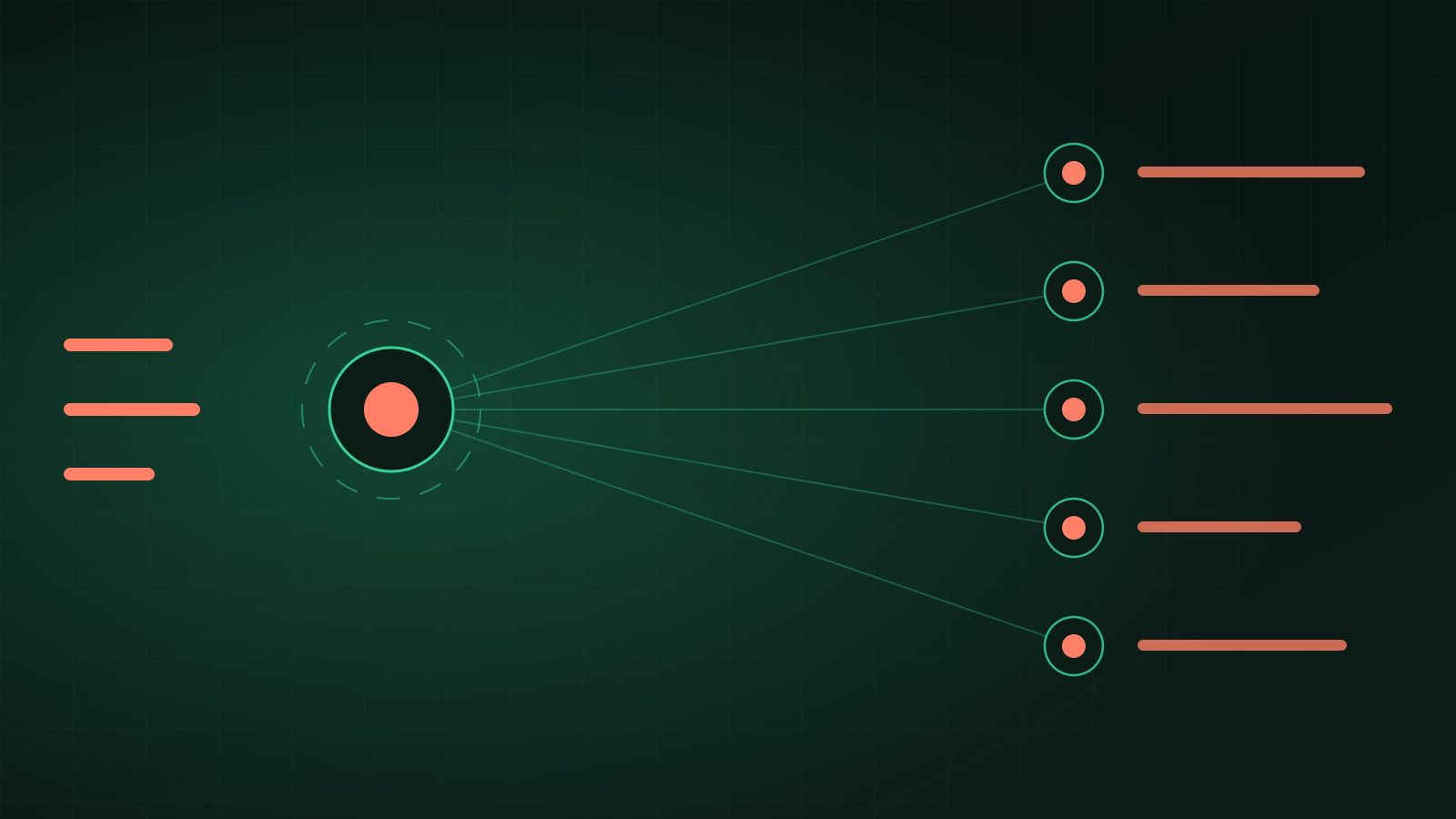
An AI agent is a system that receives a goal, selects permitted tools, and executes successive task steps within defined boundaries. It can classify tickets, retrieve data, prepare a draft result, and hand the case to a human. It is not an autonomous "employee without oversight" nor merely a chat window.
When you need this
- Your team handles many similar tickets, documents, or queries, but each requires a touch of interpretation.
- Work spans several tools and ends in a concrete action, not just a text reply.
- A deployed chat AI cannot close the case or pass it to the proper system.
- You want to see what the agent did, which data it used, and when it asked a human for a decision.
Agent, chatbot, or automation?
| Solution | When it fits |
|---|---|
| Chatbot | user needs an answer or navigation through content |
| Automation | steps and rules are fixed, exceptions rare |
| AI Agent | task requires interpretation, choice of action, or work on unstructured data |
| Multi-agent system | process has multiple specialized roles and separate verification stages |
We pick the simplest solution that closes the task. An agent is not a reward for using trendier technology.
What tasks can an AI agent perform?
- classify tickets and draft replies based on a knowledge base;
- read documents, extract defined information, and route the case onward;
- conduct research per a defined plan and record sources;
- qualify a lead against explicit criteria and enrich data in CRM;
- observe system events and trigger permitted responses.
Every scenario has boundaries: a tool list, limits, data available to the agent, and moments when the decision returns to a human.
What you get
- a process map and the criteria we use to evaluate the outcome;
- an agent connected to agreed tools and data sources;
- safety rules, permissions, action logging, and a human-takeover path;
- a test case suite and quality evaluation results before launch;
- deployment, monitoring, and documentation for ongoing maintenance.
An agent handling a business process costs approximately 8,000–30,000 PLN. A simple assistant or chatbot typically falls in the 3,000–8,000 PLN range but does not execute a full process. Final scope depends on integrations, data, permissions, and required human oversight.
How we deploy an AI agent
First we select one task with a measurable start and end. We check whether regular process automation suffices, describe data and exceptions, then build a small test scope. Only after quality evaluation do we connect it to production systems, enable monitoring, and gradually expand permissions.
If the agent must answer from company knowledge, we organize sources within second brain. If the task requires several distinct roles and cross-verification, the right direction is multi-agent systems.
What proof do we have?
In our AI research workflow laboratory we demonstrate the systems we use in our own work to break down tasks, delegate them, and verify results. This is our own product, not a client reference. That lets us show the mechanism and its limits without implying deployments that never happened.
When an AI agent is the wrong choice
We don't start with an agent when the process has no owner, the outcome cannot be evaluated, input data is disorganized, or an error could cause immediate irreversible consequences without human approval. First we organize the process, narrow permissions, or run a pilot.
Want to evaluate a specific process? Describe its start, outcome, and exceptions in the brief. If rules are fixed and a simpler solution suffices, the right entry point is the First Automated Process product.
FAQ
How is this different from ChatGPT?
The agent works in your process and on your data, with access to tools and integrations — not in a disconnected chat window. It has a task to complete, not just a conversation.
Does the agent hallucinate?
We limit hallucinations through retrieval from approved company sources (RAG), safety rules, and verification stages. Where needed, a human approves the result. Risk cannot be eliminated entirely, so we measure quality on real cases.
Is it safe for our data?
We choose the architecture based on data type and risk: we restrict agent access, isolate secrets, log actions, and define what information may reach the model provider. GDPR and retention requirements must be confirmed for the specific process.
Will the agent replace regular automation?
Not always. If the process has fixed rules, simpler automation is usually cheaper and easier to predict. We add an agent where unstructured text must be interpreted, a tool chosen, or context reacted to.
How do you verify the agent works correctly?
Before deployment we build a set of real test cases and expected outcomes. After launch we monitor executions, errors, and situations requiring human takeover.